
Most singers believe their vocal problems start in the throat.
Strain. Cracking. Running out of air. Tension on high notes.
But in reality, these issues almost always begin before the sound is even made, with breathing for singing.
Not “breathing” in the casual sense (everyone breathes), but how air is taken in, managed, and released while singing, often referred to as diaphragmatic breathing for singers.
I break this down in full in my singing course.
Click for more information👉 Singing for Visual Learners
Breathing Is Not About Getting More Air
One of the biggest misconceptions in singing is the idea that you need to take more air.
In reality, singing is about using the right amount of air, in the right way, at the right time.
When singers try to “take a big breath,” they often:
-
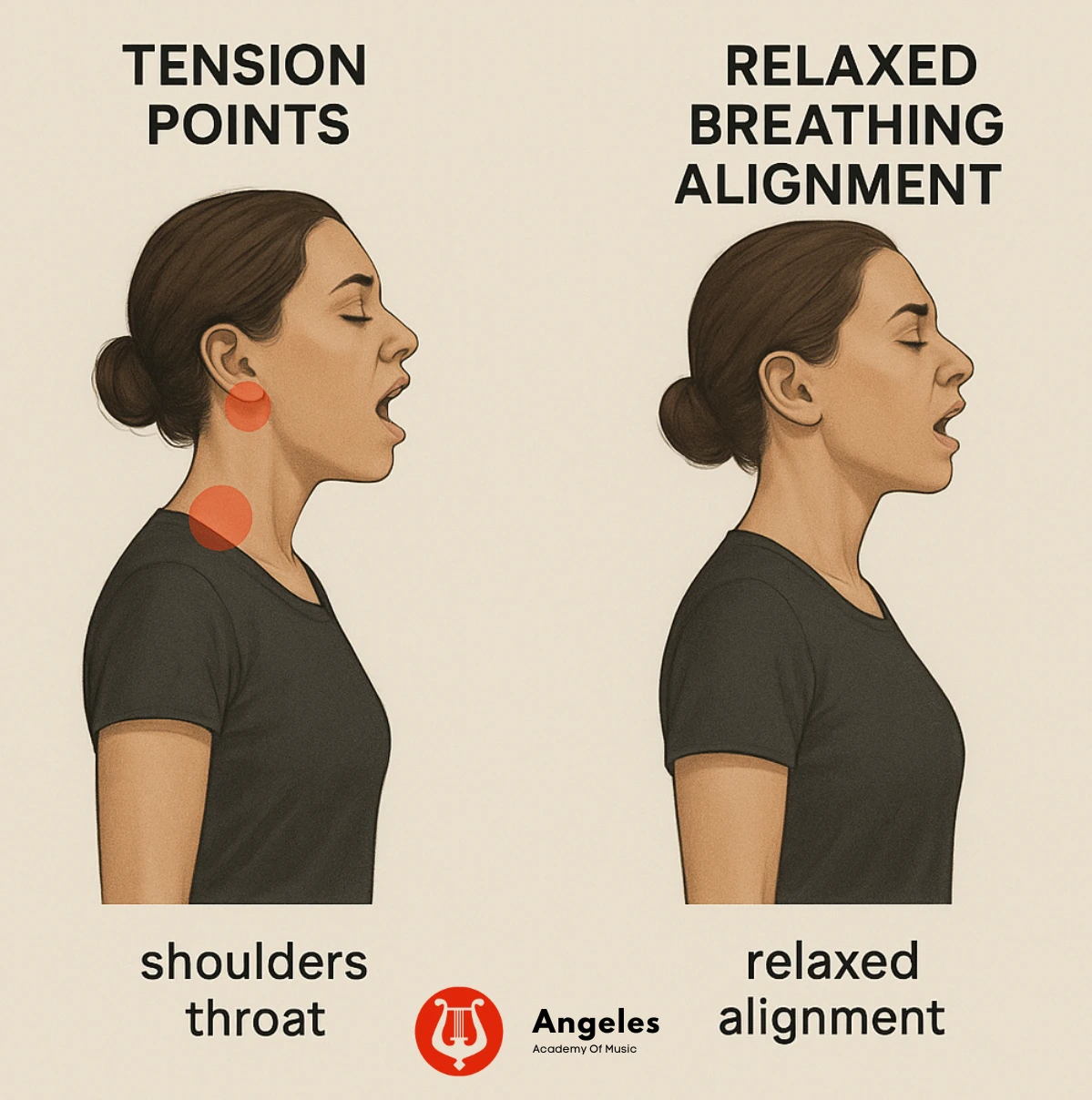
Lift the shoulders
-
Tighten the chest
-
Overfill the lungs
-
Create tension before singing even starts
Ironically, this makes the voice less stable, not more.
Great singing comes from efficient breathing, not maximum breathing.

The Role of the Diaphragm (and the Big Misunderstanding)
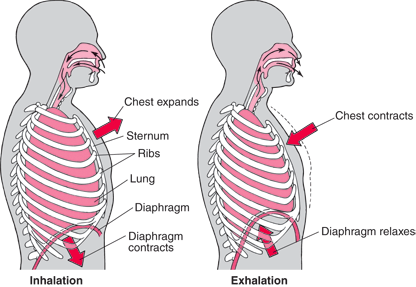
The diaphragm is a dome-shaped muscle that sits beneath the lungs.
When you inhale, it descends, allowing the lungs to fill with air.
Here’s the key point most people miss:
You cannot consciously control the diaphragm directly.
What you can control is what happens around it.
When breathing is efficient:
-
The ribs gently expand outward
-
The belly releases naturally
-
The chest stays calm and relatively still
This creates a stable, low-pressure system that supports the voice without forcing it.
Breathing for Singing vs. Breathing for Life
Normal breathing is passive.
Singing is active.
In singing:
-
Air must be released slowly and evenly
-
The ribs must resist collapsing
-
The breath must last longer than it naturally wants to
This controlled resistance is what singers call breath support.
Not pushing.
Not squeezing.
Not holding.
But managing airflow so the vocal cords can vibrate freely and consistently.
Why Poor Breathing Creates Vocal Problems
When breath is unstable:
-
The throat compensates
-
The jaw tightens
-
The tongue pulls back
-
High notes feel “hard”
-
Long phrases become impossible
The voice is simply trying to survive with the tools it has.
When breath is stable:
-
The throat relaxes
-
Pitch becomes easier to control
-
Tone becomes fuller and clearer
-
The voice feels lighter, even on powerful notes
Breathing doesn’t just support the voice, it protects it.
The Real Goal of Good Breathing
Good breathing is not something the audience should notice.
If breathing is working correctly:
-
Singing feels easier
-
Notes feel more predictable
-
The voice responds instead of resists
-
You stop “fighting” your sound
The voice begins to feel like it’s working with you, not against you.
Breathing is invisible, but it is the engine behind everything you hear in a great singer.
When that engine is built correctly, everything else becomes easier to learn.
Inside my Singing Course for Visual Learners, I break this concept down clearly and visually, so you don’t have to guess what your body should be doing.
In the course, you’ll learn:
-
Proper breathing for singing (fully broken down)
-
How to build real breath support without tension
-
How to find and control your mix voice
-
How to sing high notes without strain
-
Chest voice, head voice, falsetto, and belting
-
Jaw, tongue, and throat release
-
Pitch control, resonance, and vocal stability
The course takes you from basic fundamentals all the way to advanced coordination, step by step, using clear diagrams and visual demonstrations.
🎤 If you’re ready to stop guessing and start understanding how your voice actually works: 👉 Singing for Visual Learners
Moonelle